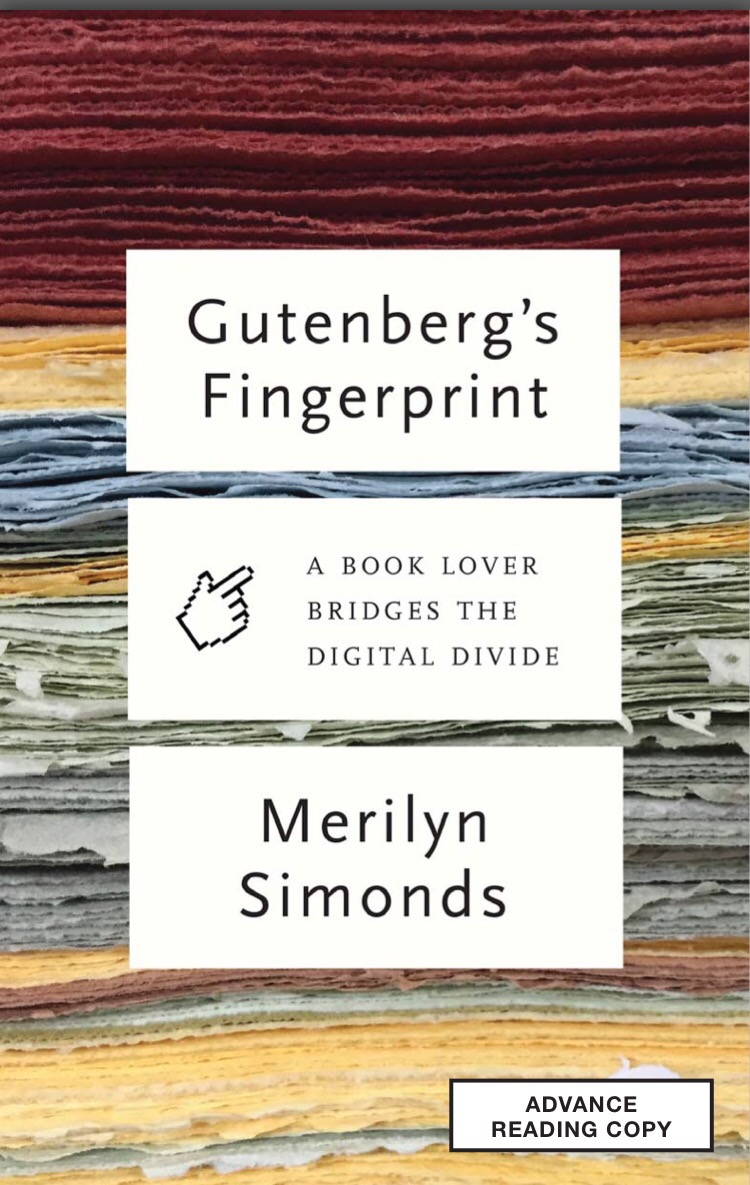
 My favourite nonfiction subject is publishing. I love reading about the history of books and how they are printed. I was so excited to have the opportunity to get an ARC of Gutenberg’s Fingerprint from ECW Press.
Merilyn Simonds writes about the process of publishing her book The Paradise Project, a collection of flash-fiction stories. She chose to have this book printed by Thee Hellbox Press, a small press in Kingston run by Hugh Barclay. Hugh is very particular about his printing, so he took good care of Merilyn’s book. He involved her in the whole process, from setting the type, mixing the ink, and printing the proofs. The endpapers were even created using the flowers from her garden!
Throughout her story of the creation of her book, Merilyn gives some history on how ink and paper are made. These stories made me smile, reminding me of my book history course in university.
The irony that I was reading a book about the history of printing on an ereader was not lost on me. Merilyn created a digital edition of The Paradise Project with her son, Erik. She discusses how ebooks have changed the publishing industry, but print books aren’t going anywhere soon. Printing has evolved from scribes writing on vellum to machines stamping ink on paper to pixels appearing on a screen. Technology is still evolving the way books are delivered to the reader, but it couldn’t be done without Gutenberg’s press.

 Jill's Book Blog